

Marketing and the transformational experience
Marketing and the transformational experience
Students travel to Southeast Asia for a once-in-a-lifetime academic experience
For Clifford Shultz, marketing is about more than identifying customers and finding the best ways to reach them. He thinks of it as a way to solve some of the world’s most pressing problems.
“It’s about using marketing tools to improve the human condition in complex systems, and to improve the quality of life for individual people and their communities,” said Shultz, professor and Kellstadt Chair in Marketing at Loyola University Chicago’s Quinlan School of Business.
Shultz has been taking graduate (and some undergraduate) students to Southeast Asia for more than three decades as part of his immersive course, Comparative Marketing and Consumer Behavior in Vietnam, Cambodia, and Thailand. After academic study in Chicago, Shultz leads the students on an experiential learning trip to the three Asian nations to see three distinct cultures and developing economies firsthand.
The course is an example of the Quinlan School of Business’s commitment to experiential learning and encouraging students to prioritize both profit and purpose in their work.
Deep cultural connections
Shultz, who has been studying and meeting with colleagues, consumers, business executives, and political leaders in Southeast Asia for much of his career, is a true guide and mentor.
“Students have a chance to meet and ask questions of people running NGOs, or high-level governmental officials. His course provides the kind of access and types of conversations that most students rarely experience,” said Dinko Bačić, associate professor of information systems.
“Cliff is a world-renowned researcher in international marketing, so when he takes you somewhere, get ready, because the depth of context and conversation is going to be unlike any other.” Dinko Bačić, Associate Professor of Information Systems
More than a textbook
After a semester of work in the classroom, the immersion in Southeast Asian cultures provides the students a capstone like no other.
“The way the weather feels on your skin, the heat and humidity, the sensory richness and the sites, all provide a real intensity,” said Shultz. “The course is so much about engaging with the people, learning norms and conduct firsthand, and having to adjust in real time to the myriad unfamiliar experiences that are inevitably encountered during immersive field study.”
Shultz has incorporated a strong interdisciplinary element in the course, which includes professors from other departments—like Bačić—who says it is another aspect of the course that makes it so intellectually rich.
Where brilliance meets purpose
Innovative Research
Breaking ground with biometrics
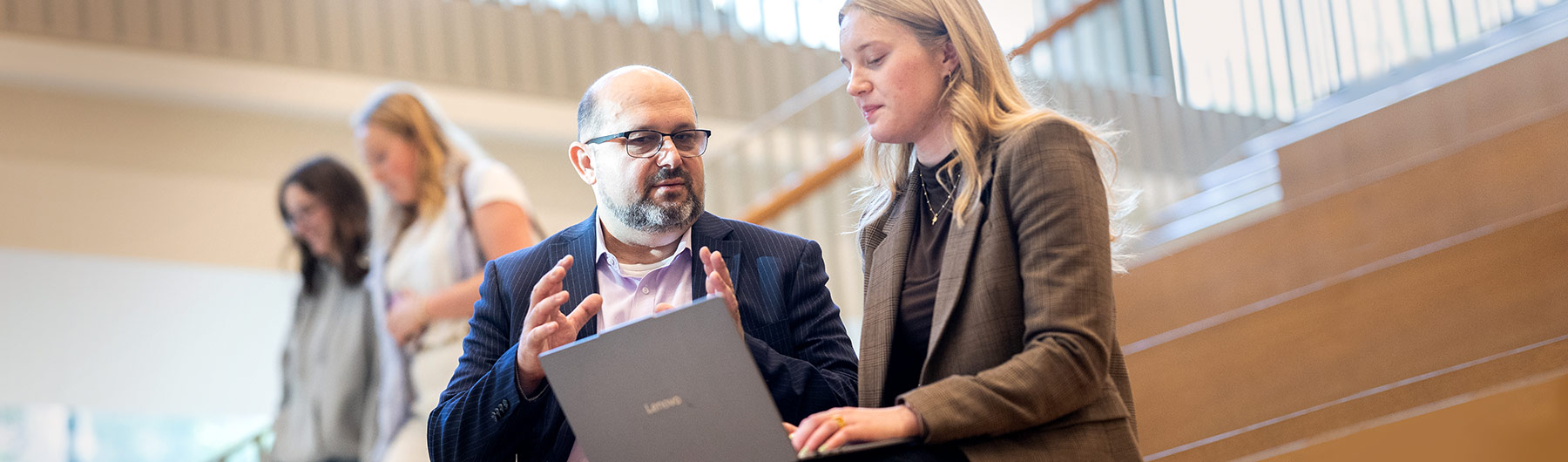
Associate Professor Dinko Bačić’s UX and Biometrics Lab is at the forefront of bringing professional research tools to business students.
Read about biometrics at Quinlan
Research Collaboration
Elevating behavioral research
Cutting-edge business research on how people think, feel, and behave has a home at Assistant Professor Brittney Bauer’s Behavioral Lab.
Read about a hands-on research lab
Business Ethics
Leadership tools for the real world
Quinlan’s long legacy of leadership in business ethics continues in Associate Professor Abraham Singer’s courses and research.
Read about ethics in the curriculum“When you bring in other faculty members with different lived experiences to connect with, very quickly the walls come down and you’re talking about finding ways to collaborate,” said Bačić.
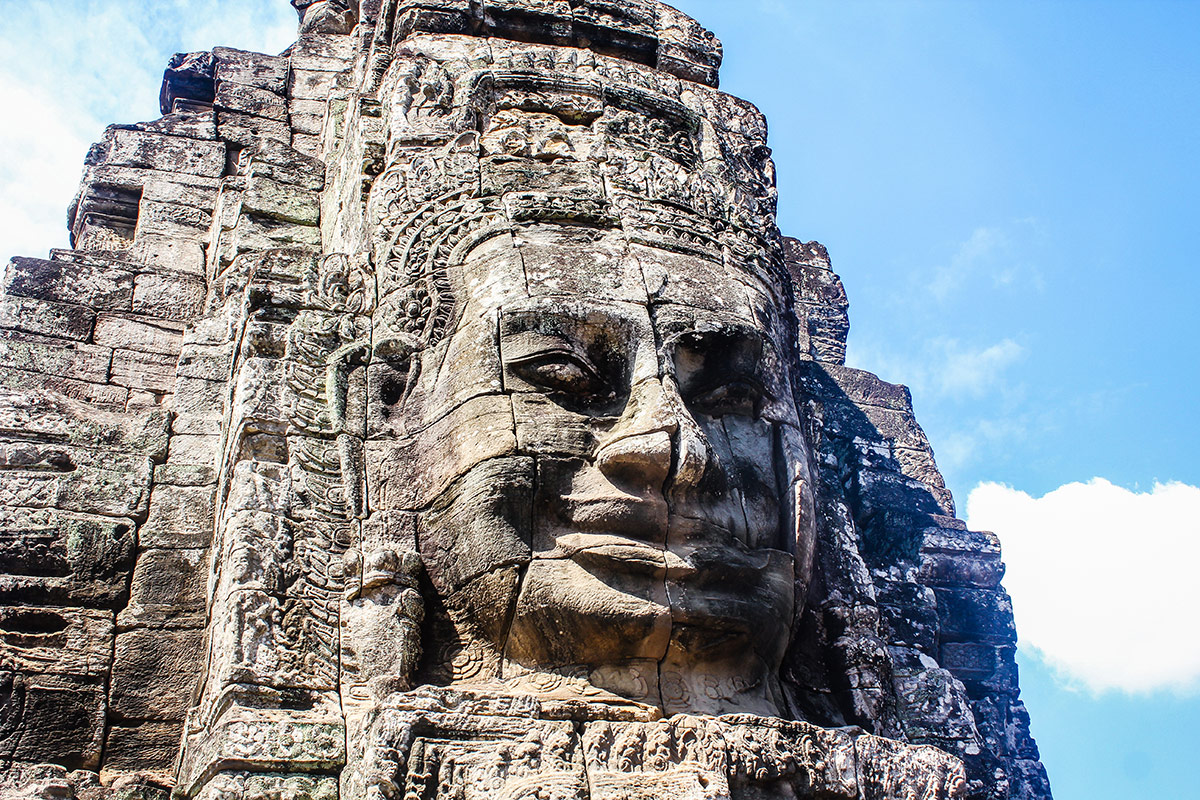
Last year, Molly Melin, a professor of political science whose research focuses on international conflict, joined the trip, bringing expertise on how governmental policies affect peace following a conflict. The trip included a sunrise exploration of Angkor Wat, and a visit to an elephant sanctuary, as well as panels and lectures on infrastructure, entrepreneurship, good governance, poverty-reduction and healthcare, urban development, tourism, and sustainable marketing and consumption.
“The Southeast Asia course was one of the most impactful classes I took in the MBA program,” said Ankica Runac (MBA '10), a marketing and branding executive.
“The course pushed me to think globally, to recognize how culture and context completely change the way you approach business, and to stay curious about markets I might not have otherwise explored.” Ankica Runac (MBA '10), marketing and branding executive
Transformational education
There is also a service-learning component to each trip. This year, the students traveled to Cambodia at the invitation of the Ponheary Ly Foundation, where they met and prepared a meal for children at the foundation’s Romchek School, built on a site that is a reclaimed minefield.
“These kids walk or bike miles to come to school. A lot of them don’t have shoes and often can’t attend school because they have to help with work in the fields so their family can survive,” Shultz said. “This is a chance for our students to see what many parts of the world are really like. There are some wet eyes after that experience.”
Melin said the Cambodian tour guide for their class had lost his family to the Khmer Rouge. “To talk to people who were affected by Pol Pot’s genocide, it’s a lot different from hearing me talk or seeing numbers on a blackboard,” Melin said. “Hearing what he lived through—it isn't just something that's a paragraph in a history book somewhere—enabled people to really put a face to suffering in a way that you can't otherwise.”
Lasting impact
Students regularly report how the class and trip have expanded their outlook on their work and the world. “Professionally, I still draw on the mindset I developed on our trip, whether it’s shaping strategy, navigating cross-functional work, or simply asking better questions about why people make the choices they do,” Runac said.
“So many of our students say, ‘I left this place feeling like I connected with these people, and I can make a difference,’” Shultz said. “Some of them go back to Southeast Asia and get jobs with businesses, NGOs, and universities, and some apply lessons from the course to assist organizations and neighborhoods in Chicago and elsewhere. This class is a true example of what Quinlan means to have a transformative experience. It changes our students’ lives–and the lives of people in Vietnam, Cambodia, and Thailand.”
More than a textbook
After a semester of work in the classroom, the immersion in Southeast Asian cultures provides the students a capstone like no other.
“The way the weather feels on your skin, the heat and humidity, the sensory richness and the sites, all provide a real intensity,” said Shultz. “The course is so much about engaging with the people, learning norms and conduct firsthand, and having to adjust in real time to the myriad unfamiliar experiences that are inevitably encountered during immersive field study.”
Shultz has incorporated a strong interdisciplinary element in the course, which includes professors from other departments—like Bačić—who says it is another aspect of the course that makes it so intellectually rich.
“When you bring in other faculty members with different lived experiences to connect with, very quickly the walls come down and you’re talking about finding ways to collaborate,” said Bačić.
Last year, Molly Melin, a professor of political science whose research focuses on international conflict, joined the trip, bringing expertise on how governmental policies affect peace following a conflict. The trip included a sunrise exploration of Angkor Wat, and a visit to an elephant sanctuary, as well as panels and lectures on infrastructure, entrepreneurship, good governance, poverty-reduction and healthcare, urban development, tourism, and sustainable marketing and consumption.
“The Southeast Asia course was one of the most impactful classes I took in the MBA program,” said Ankica Runac (MBA '10), a marketing and branding executive.
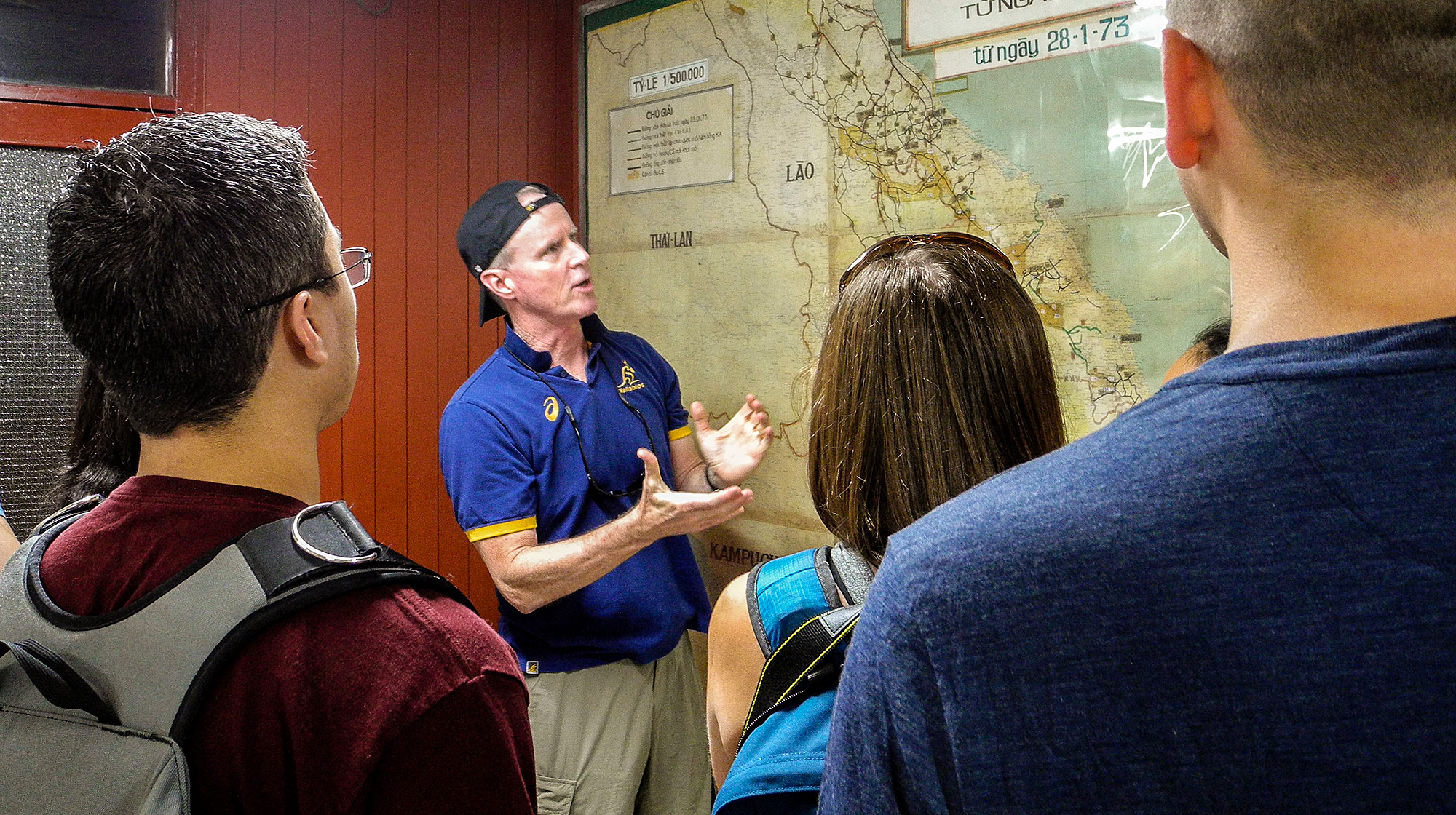
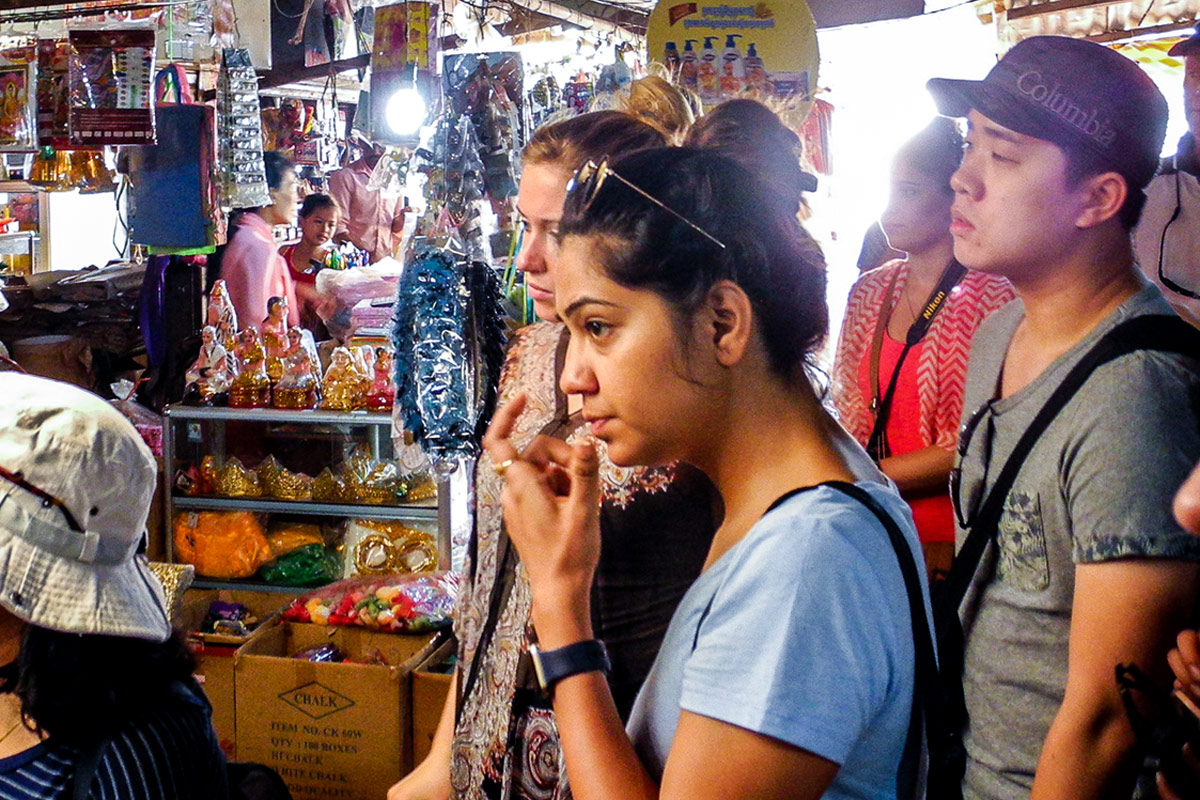
Professor Clifford Shultz (top) talks to students in Vietnam. Below are scenes from the course in Southeast Asia.
Transformational education
There is also a service-learning component to each trip. This year, the students traveled to Cambodia at the invitation of the Ponheary Ly Foundation, where they met and prepared a meal for children at the foundation’s Romchek School, built on a site that is a reclaimed minefield.
“These kids walk or bike miles to come to school. A lot of them don’t have shoes and often can’t attend school because they have to help with work in the fields so their family can survive,” Shultz said. “This is a chance for our students to see what many parts of the world are really like. There are some wet eyes after that experience.”
Melin said the Cambodian tour guide for their class had lost his family to the Khmer Rouge. “To talk to people who were affected by Pol Pot’s genocide, it’s a lot different from hearing me talk or seeing numbers on a blackboard,” Melin said. “Hearing what he lived through—it isn't just something that's a paragraph in a history book somewhere—enabled people to really put a face to suffering in a way that you can't otherwise.”
Lasting impact
Students regularly report how the class and trip have expanded their outlook on their work and the world. “Professionally, I still draw on the mindset I developed on our trip, whether it’s shaping strategy, navigating cross-functional work, or simply asking better questions about why people make the choices they do,” Runac said.
“So many of our students say, ‘I left this place feeling like I connected with these people, and I can make a difference,’” Shultz said. “Some of them go back to Southeast Asia and get jobs with businesses, NGOs, and universities, and some apply lessons from the course to assist organizations and neighborhoods in Chicago and elsewhere. This class is a true example of what Quinlan means to have a transformative experience. It changes our students’ lives–and the lives of people in Vietnam, Cambodia, and Thailand.”